
 Polski
 Deutsch
 Русский

Our Warszawa in the Album "Piękne klasyki na Warmii" (Beautiful Classics of Warmia)
- 15 Sep, 2014
- Nasza Warszawa
- 0 Comments
This will be a dream of a Warszawa—though it all happens to be true. An ivory-colored Warszawa drives around Olsztyn, bearing on its doors a distinctive, old-style-inspired sign: "Przedsiębiorstwo reklamowe Agraf" (Agraf Advertising Company). It belongs to Rafał Sadowski—as does Agraf, for that matter. One might think it is a rolling advertisement for the company. Indeed, that too. But Rafał treats the over-40-year-old Warszawa as a means of tourist transport. Where hasn't he taken it. All in all, he counted 13 countries he has toured with the help of the Warszawa. This time, though, it is not about travels, because quite recently, in a rather casual conversation, it turned out that I know a piece of this Warszawa's past—unknown to its owner—the Warszawa that made its way to Olsztyn from Gdynia. I happened to be living there as a rookie reporter for Gazeta Wyborcza. I pushed myself to the heights of a craft barely carried out of university and rushed off to produce my first feature about the supposedly cult figure of Mr. Janek, who by the Gdynia-Chylonia station waits for customers at the taxi rank in no ordinary car, but a gray-blue Warszawa. For a quarter of a century! Indeed, Mr. Janek was a story that told itself. He poured out tales from the golden days, when he would drive sailors returning from voyages, their pockets stuffed with foreign currency, around the Tricity dance halls. Mr. Janek grew so attached to the Warszawa that he gave it a name—Kasia. He also told me the story of how Olaf Lubaszenko, then shooting his directorial debut "Sztos" in the Tricity, spotted Mr. Janek right at the rank in Chylonia. And he recruited him, along with the Warszawa, onto a film set placed in the 1970s. Kasia played a cameo in "Sztos," but at the editing stage the scenes filmed with her did not make it into the movie. Eight years ago, Rafał Sadowski bought the Warszawa from Mr. Janek. He tracked it down through an online portal among three other "Warszawa" specimens. The Gdynia one, however, shared with Rafał the fact that they came from the same year, so the choice was a mere formality. "I remember that when I drove it out onto the street, I immediately ended up in the neighboring lane. That is how much play it had. Mr. Janek also suggested not exceeding sixty. No wonder, since the wheels were unbalanced. It took me six hours to get back to Olsztyn," he recalls. Worn out by a million kilometers, the Warszawa had to undergo a complete restoration. For two years. Since the restoration, the Warszawa has covered over 50 thousand km, not only in Poland but also in Lithuania, Latvia, the Netherlands, England, Scotland, Germany, the Czech Republic, Slovakia, Sweden, and Russia. This year it was in Vilnius. In the old town, surprised Poles said enthusiastically: look, our Polish Syrena in Lithuania.
.jpg)
Since it had changed color in the meantime, I would never have guessed it was the Gdynia taxi I knew. So I picked up the trail of the Warszawa's origin during a casual discussion, a good two years into knowing Rafał. "From Gdynia? From a taxi driver? From Chylonia?!" I pressed like an investigator. When we cracked the riddle of the color, I felt almost as if I had found the Amber Room. From among the first newspapers with my own work that I had kept as mementos, I dug out for Rafał a copy from October 14, 1999, with the feature "Kasia nie do zdarcia" (Kasia, the Indestructible).
Mr. Janek, wherever you are now, you married off your Kasia to a decent son-in-law.
Rafał Radzymiński
.jpg)
A Comrade from the Agency
And it all began on November 6, 1951, on the eve of the anniversary of the October Revolution—the first Warszawa M20 rolled off the FSO assembly line in Żerań. Supposedly it was not a Warszawa at all, but a Pobeda GAZ 20 brought in whole from the Soviet Union—the prototype of our heroine. Since back then we loved only and exclusively Big Brother, and he generously helped us, we received the license for free, which was of course announced far and wide. We only had to buy a few extras at "promotional prices": technical documentation—130 million PLN; dies and machines—250 million PLN, all set. In 1964, the body styling was changed to the "redan" shape. This model was designated 204 in the side-valve version and 203 in the overhead-valve version.
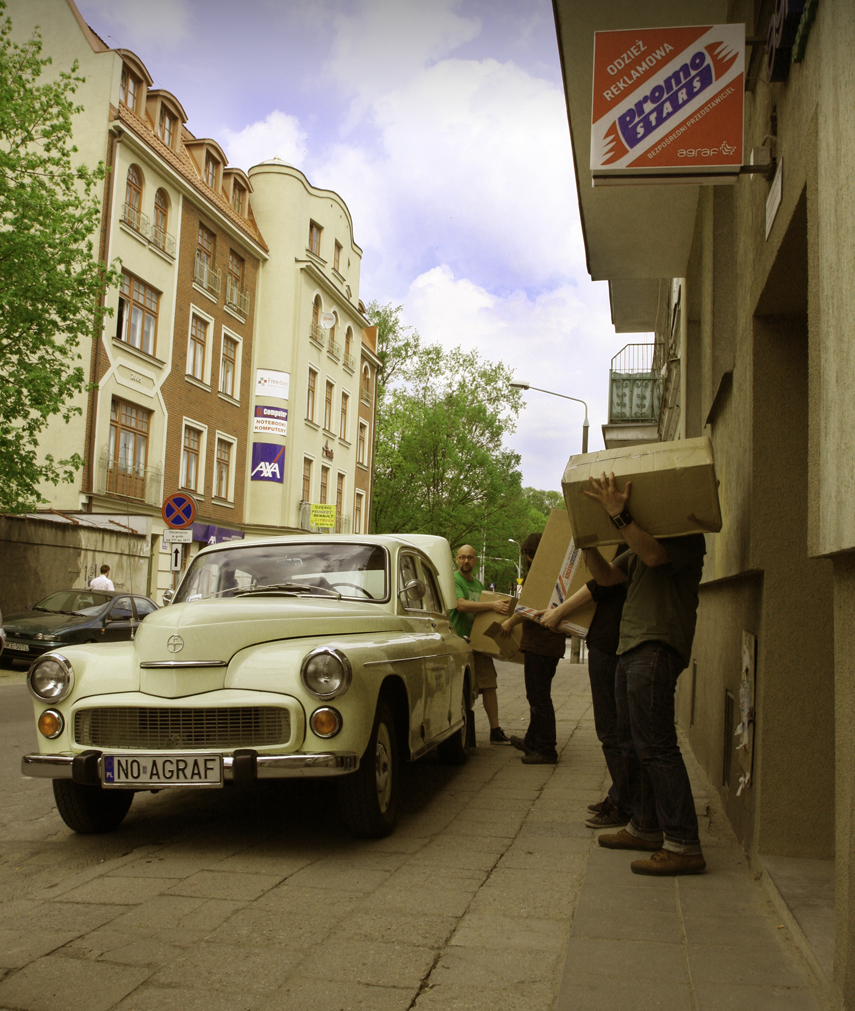
The Warszawa, a "working woman." Over the decades of our socialist and capitalist history, the Warszawa is a "working woman who fears no work"—for instance in health care, in the irreplaceable Milicja Obywatelska (Citizens' Militia), in the service of the church (Karol Wojtyła's Warszawa), as a "workhorse," and, well, as a company car…
…the Agraf Advertising Agency.
I use my Warszawa almost every day as a company vehicle. When you are short on time, you can hold your own "vintage vehicle rally" during working hours and enjoy the drive on your way to meet a client. It is a very rewarding car, long-lived and reliable—as long as we service it regularly, take up any play, and replace worn parts. And mechanical parts are still available, fairly cheap, since they are interchangeable with parts for the Żuk, Nysa, and Tarpan, and largely with those for the Soviet Volgas and GAZ cars.
Rafał Sadowski







0 Comments