Today, practically every adult uses a calendar, whether it's an electronic, pocket, desktop or wall version. It wasn't always like that.
In Roman times, the high priest announced to residents on the first day of the month how long the starting month would be and which holidays would fall during it. This information was recorded in the calendarium book, which took its name from the Latin word calendae, meaning the first day of the month.
The Egyptian calendar initially had 10 thirty-day months, and in order to measure time based on the Earth's movement around the Sun rather than the Moon, it turned out that two additional months had to be added. The easiest way to explain such a solution was through myth — the god of astronomy and mathematics Thoth won those two months in dice from Osiris, the god of life and death.
The solar calendar, otherwise known as the Julian calendar, was created thanks to Julius Caesar, was in force in the Roman state, replaced the Byzantine calendar and stayed with us for a long time (it is even used by some churches today). It was the Julian calendar that announced the year begins on the first of January, which introduced the so-called annus confusionis (Latin: year of confusion), because earlier (in the Byzantine calendar) the year began in September and lasted 445 days. It was the Julian calendar that set the year at 365 days and introduced the leap year every 4 years.
The last change was introduced in 1582 by Pope Gregory XIII, and thus the Gregorian calendar, valid until today, was born. Honestly speaking, the Julian and Gregorian calendars are almost identical. They differ only in the size of the error — the Julian calendar was one day late every 128 years, while the Gregorian one only every 3322 years.
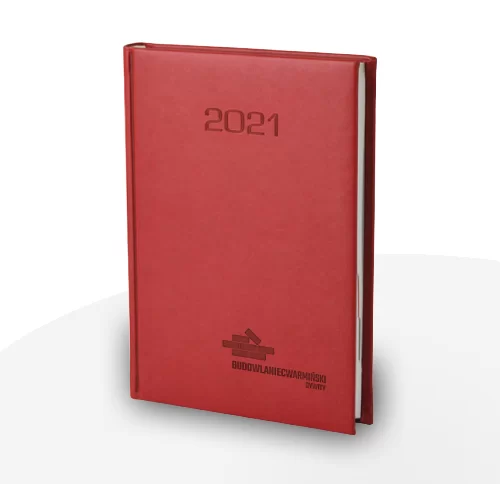
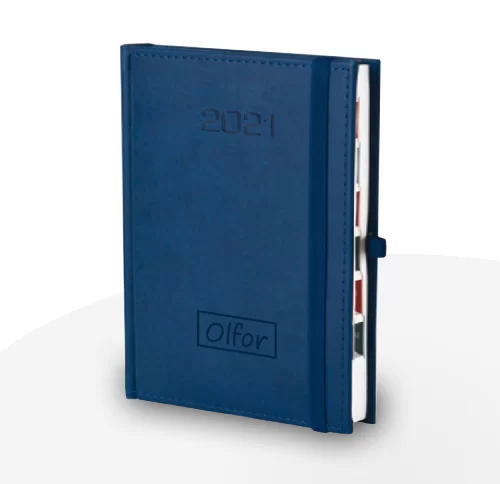
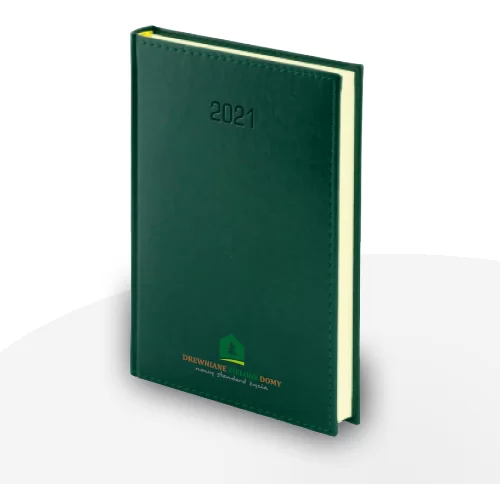
A very practical gadget, giving plenty of space for notes and helping to organize tasks, plans or meeting appointments. Thanks to its handiness it will easily find a place in a pocket, briefcase or on a desk. You can always have it at hand, not just on the wall.
We typically distinguish A4 format (the largest, slightly bigger than an application sheet), B5 (for those who need a bit more space than A5), A5 (similar in size to a regular notebook), and B6 (also known as pocket size).
Once we have chosen the appropriate format, the next choice is the layout, and here we distinguish two: daily layout and weekly layout.
In the daily layout, each day takes a separate page, with only Saturday and Sunday usually presented together on one page. In the weekly layout, on one page we have Monday, Tuesday and Wednesday, and on the other (opposite) the rest of the week.
When it comes to binding, we have a huge selection. It can be leather, leather-like, fabric or combined. Additionally, a wide range of colors will satisfy even the most demanding user. The most often chosen and most cost-effective is Vivella binding, followed by Nebraska.
Book calendars are most often embossed — first a matrix is created, thanks to which a logo imprint is then made. The matrix has an advantage over other methods in that it can be reused in subsequent years as long as it does not change. If we need to present the logo in a colored version, because color is the most important distinctive feature, then we can do digital printing. For smaller quantities and logos that often change, we suggest laser marking.
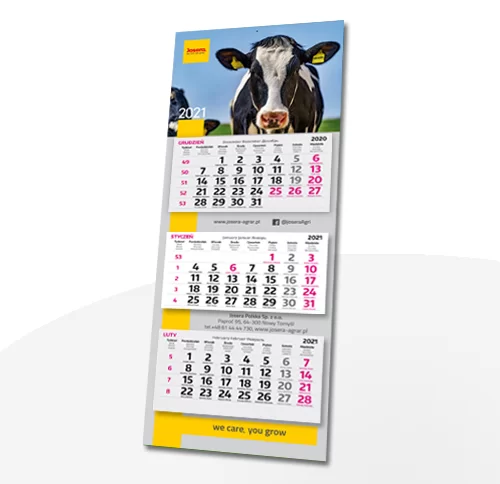
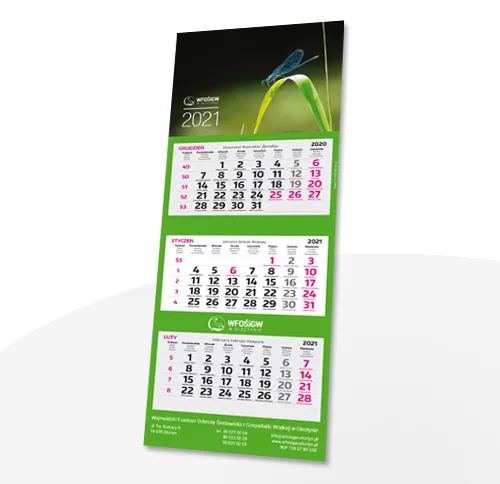
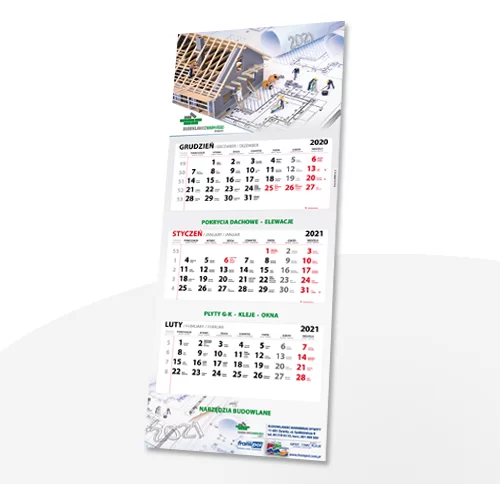
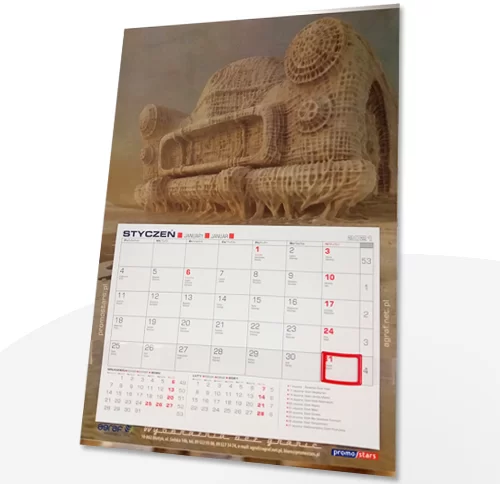
The three-part calendar is probably the calendar most often hosted on our walls. Slim, legible, and thanks to the layout of three calendariums (previous, current and next month), very practical. The main and leading graphic is placed on the header, and the space below the calendariums is most often used for a slogan presentation of the services offered and address details. Thanks to our graphic studio, such a calendar will additionally be not only an advertisement but also a decoration, because even an ordinary factory can be presented in an artistic and interesting way.
Here we can distinguish a calendar with a flat header (the header is printed together with the backing) and a convex / cashed header, that is glued to the backing and made of solid cardboard.
If we care about the lowest possible price, you can choose a version with white backings to which the calendariums are glued.
In most cases, we can choose between matte foil and gloss foil covering the header. The backings have standard finishing without foil.
A very functional addition is a sliding window for marking the date. A cardboard envelope can also be ordered for the calendar, which additionally adds prestige when presenting this gadget.
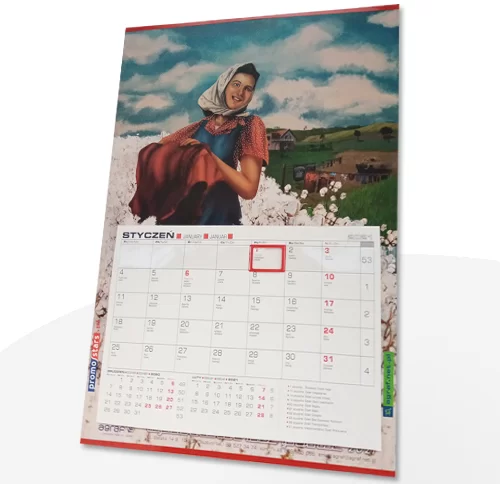
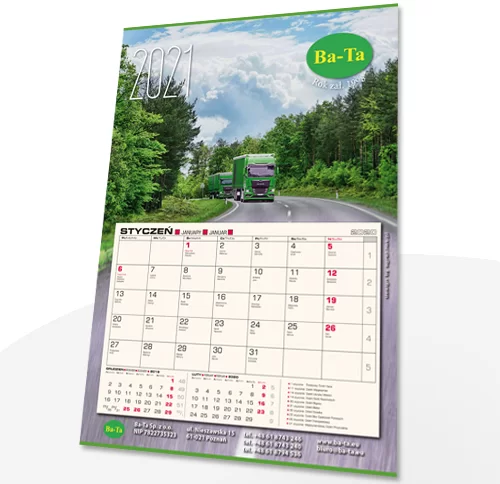
Our company idea, which has gained a large group of recipients. It is characterized by a large format, large original calendarium with plenty of space for notes (our friends call it the "dentist's calendar", because the large squares in the month are ideal for writing down an upcoming appointment), great functionality and a very large area for presenting the project, which our designers will gladly prepare.
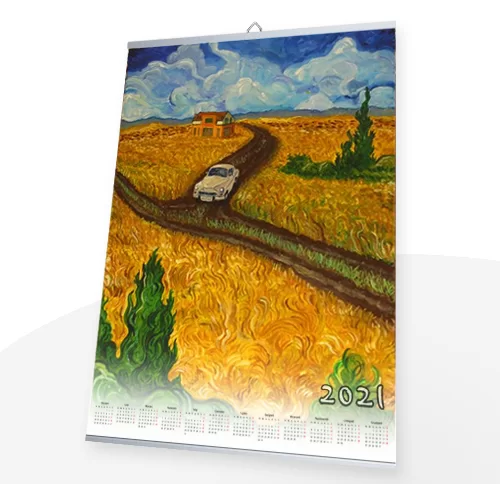
This calendar features a year-round calendarium, which on a large surface ideally presents not only the layout of months, but also provides huge advertising space. On such a large surface, we can show the company profile with one large main graphic motif, a collage of photos, or, for example, a set of information helping in work throughout the year.
Here we have a very wide selection of calendar formats that we can adapt to our needs: A3 (297 x 420mm), A2 (420 x 594mm), A1 (594 x 841mm), B2 (480 x 680mm), B1 (680 x 980mm).
We can also change the quality of the calendar depending on the paper quality/thickness. We have at our disposal glossy coated paper with a grammage of 170g and 250g, and matte coated paper with a grammage of 170g, 250g and 350g.
Finishing: standard, matte foil, gloss foil or matte foil + selective UV varnish
Depending on the calendar layout (vertical or horizontal), we distinguish top-bottom strips mounted along the short or long side in silver, white or black color.
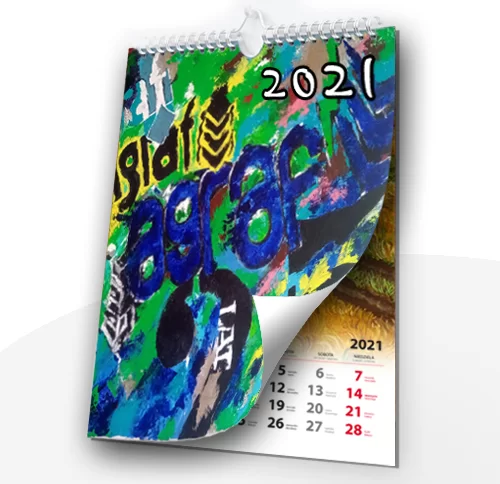
The most prestigious calendar allowing for a different graphic on each page. It is a calendar that attracts attention, delights with new graphics each month, and a legible calendarium additionally increases its functionality. It is an ideal medium for artistically presenting the company profile or graphics we want to present to our recipients (in which our graphic designers will of course gladly help).
A4 (210 x 297mm), A3 (297 x 420mm), A2 (420 x 594mm), B4 (336 x 236mm), B3 (336 x 480mm), B2 (480 x 680mm).
Here we can choose between 1+6 (cover on one page plus months on each page) or 1+12 (each month and the cover have separate pages printed single-sided).
Depending on the format (not every format, run and layout allows this configuration), we can choose: all gloss coated 250g, all matte coated 250g, gloss coated 250g (cover) + 170g (interior), matte coated 350g (cover) + 170g (interior), matte coated 300g (cover) + 170g (interior), matte coated 250g (cover) + 170g (interior), gloss coated 300g (cover) + 170g (interior).
The spiral can be placed along the short or long side depending on the layout (vertical or horizontal), and we can choose its color from four: white, black, gold, silver.
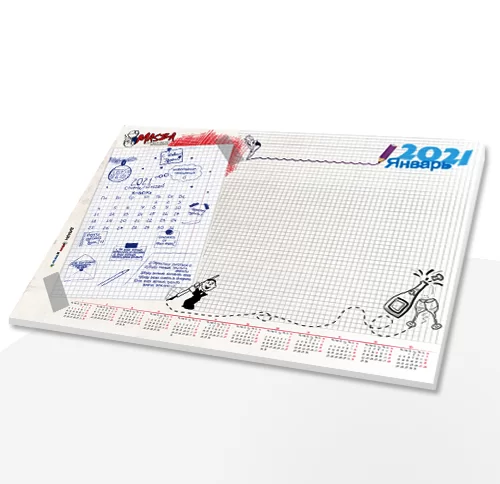
The desk pad calendar is a calendar to be placed on the desk and has universal use. It serves for handy notes, important entries, planning, or simple "doodling" that often arises unconsciously. A good design and thoughtful space planning will further enhance its functionality.
A3 (297 x 420mm), A2 (420 x 594mm), B4 (336 x 236mm), B3 (340 x 480mm), B2 (480 x 680mm)
Here we have a choice of 26 or 52 cards
We can glue the cards to the page at the top edge, bottom edge or both top + bottom.
Cards can have straight or rounded corners.
The paper is unchanged - we always print desk blotters on 90g offset paper, printed single-sided.
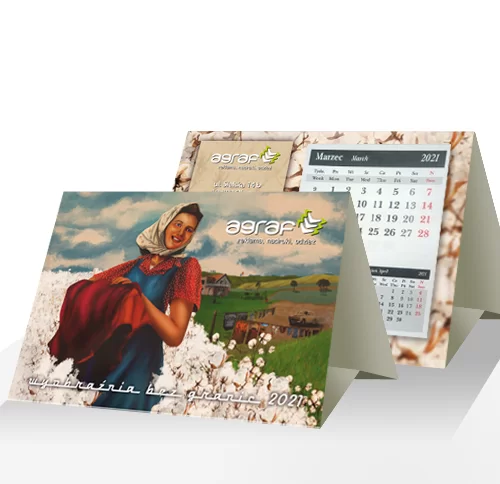
This is a small, handy desktop calendar that has a relatively large advertising space and at the same time a compact size that will always find a place on any desk. Such a calendar can have a weekly, monthly or semi-annual layout.
A5 (pyramid), calendarium 200 x 132mm + base 300 x 140mm, calendarium 300 x 132mm + base 300 x 140mm
300g cardboard, 90g offset calendariums + 300g cardboard base, 130g matte coated calendariums + 350g cardboard base, 90g offset calendariums + 350g cardboard base, 130g gloss or matte coated calendariums + 300g cardboard base.
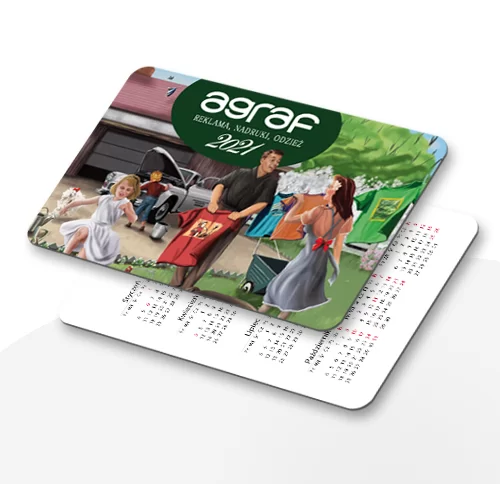
The most compact of the calendars. It can be carried in a wallet, pocket, or other small place.
Matte coated 350g
85 x 55mm
Standard, matte foil two-sided, gloss foil two-sided
Rounded or without rounding
Start typing to see products you are looking for.
This website uses cookies to ensure you get the best experience on our website. Privacy policy